Electric · 6 in line
Acoustic · 3 + 3
6th
C2
65.4 Hz
5th
G2
98.0 Hz
4th
C3
130.8 Hz
3rd
G3
196.0 Hz
2nd
C4
261.6 Hz
1st
E4
329.6 Hz
Note names won’t tune your guitar.
Knowing the strings should read C G C G C E is the easy half. Landing each frequency — and knowing whether you are nine cents flat or three — is the half that needs an ear or an instrument.
1
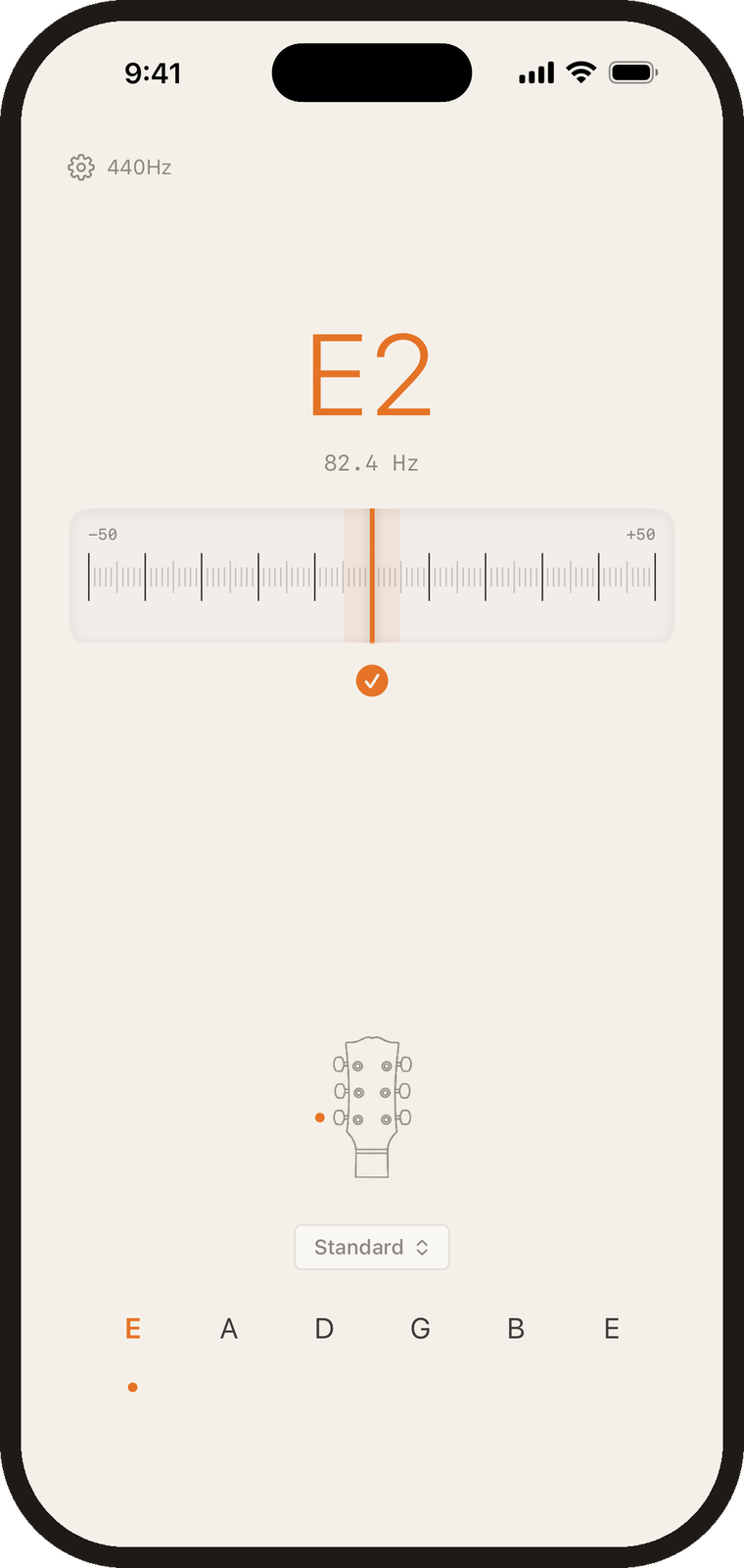
Open Dial and play a string
It listens as soon as you play. Nothing to press.
2
Turn each peg until the needle centres
Four strings move: the sixth drops two whole steps to C, the fifth to G, the fourth to C, and the second rises to C.
3
Check the remaining strings
Changing tension on one string shifts the neck slightly. The rest usually need a nudge.
Get Dial for iPhone
Standard tuning free
Alternate tunings, one-time unlock
Alternate tunings, one-time unlock
What Open C is for
The sixth string drops two full steps for a root well below standard tuning's reach. The wide spacing makes simple shapes sound orchestral — John Butler and Devin Townsend both lean on it.
A few chords to try
C
Open
F
Barre 5th
G
Barre 7th